
Small Fly, Big Challenge – the Trico Hatch
There are few things in fly fishing more captivating—or more humbling—than standing in a river at first light, watching the surface come alive with the delicate rise forms of trout feeding on insects so small that they can be difficult to see with the naked eye.
For the dry-fly angler, the Trico hatch is one of those special events that can test every part of your game: your ability to read the water, make a delicate presentation, choose the right fly, manage fine tippet, and, perhaps most importantly, remain patient when the trout seem to have an endless menu of natural insects from which to choose.
Here in Vermont, the Trico hatch has become one of the most anticipated events of the summer and early fall. On the Battenkill, these tiny mayflies can begin appearing around mid-July and, depending on conditions, continue into September and sometimes well into October. It is a morning affair, often compressed into just a few precious hours. For those willing to get up early and meet the river on its terms, it can provide some of the most rewarding—and challenging—dry-fly fishing of the season.
What Exactly Is a Trico?
The Trico is a tiny mayfly in the genus Tricorythodes. In the Northeast, Tricos are typically associated with very small mayflies, often imitated with patterns in the size 20 to 24 range. Their diminutive size is part of what makes the hatch so challenging. The flies are small, the trout can become highly selective, and the difference between a convincing imitation and an unnatural presentation can be measured in inches—or less.
Like other mayflies, the Trico’s life cycle begins underwater. The insect spends its nymphal stage in the river before emerging as a winged adult. During the emergence and mating cycle, the river can become increasingly populated with these tiny insects. Eventually, the spent adults—known as spinners—fall to the surface, creating the event that dry-fly anglers eagerly anticipate: the spinner fall.
It is during this brief window that the Battenkill can seem to transform. The river may appear quiet at first, but look closely and you’ll begin to see the subtle evidence of trout feeding. A dimple here. A nose there. Perhaps only the faintest disturbance on an otherwise glassy surface.The trout know exactly what is happening.
The Morning Game
Trico fishing is often a game of timing.The hatch and spinner fall generally occur in the morning, with the exact timing influenced by weather, air temperature, and other environmental conditions. The window can be surprisingly short. Before long, the spinner fall is over, the surface activity diminishes, and the river returns to its quieter summer rhythm. That short window is part of what makes Trico fishing so special. You have to be there. And when you are there, you have to be ready.
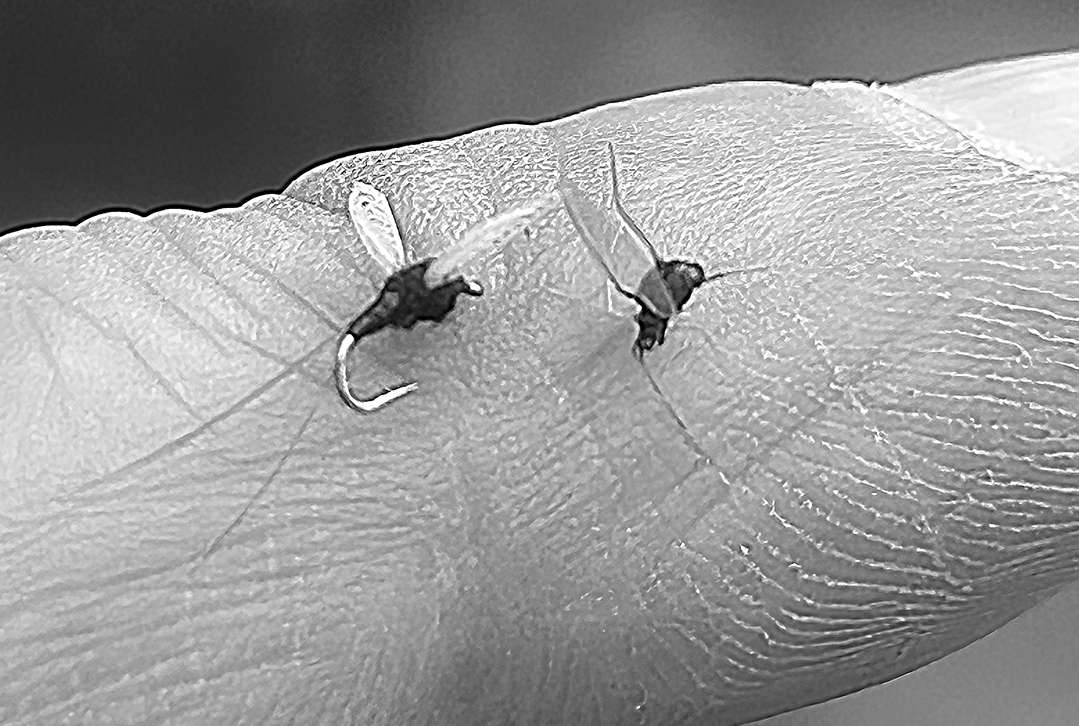
A long, fine leader. Delicate tippet. A precise cast. A fly that closely resembles the naturals. The ability to land that fly softly enough that it doesn’t disturb the water. Then comes the hardest part: waiting for the right trout to feed and making the right presentation when it does.
The Battenkill is not a river that gives up its secrets easily. During the Trico hatch, that challenge is magnified. The trout may be feeding confidently, but they are surrounded by thousands of tiny natural insects. Matching the hatch is only part of the equation. Presentation, drag-free drift, position, and patience all become critical.This is dry-fly fishing in its purest form.
Why Trico Unlimited?
For me, the Trico hatch is more than just another hatch on the calendar. I was born on 3/23, 1963. I am the third son of a third son. The number three has a special meaning in my life.
Then there is my last name: Moscarello. In Italian, “mosca” means fly, and “moscarello” can be interpreted as “little fly.”
Put those two pieces together, add my lifelong connection to fly fishing, and the name Trico Unlimited began to make perfect sense.
The trico is a tiny fly. The name Trico connects directly to one of the most fascinating and technically demanding hatches we experience here in Vermont. And the idea of “unlimited” represents the endless possibilities that come with fly fishing—the places it takes us, the people we meet, the lessons we learn, and the experiences that keep us coming back to the river. In many ways, the name Trico Unlimited was meant to be.
For the seasoned dry-fly fisherman, I can think of few better challenges than experiencing a Battenkill Trico hatch. This isn’t necessarily about catching the biggest trout or filling the net. When everything comes together, it is one of the most satisfying experiences in fly fishing. And when it doesn’t? Well, that’s the Battenkill.
That’s also why we keep coming back.
So, if you consider yourself a seasoned dry-fly angler, come to Southern Vermont, book a guided trip with Trico Unlimited, and test your skills against one of the most technical and rewarding hatches of the season.
The Tricos will be waiting. And somewhere beneath the surface, a wild Vermont trout will be waiting, too.